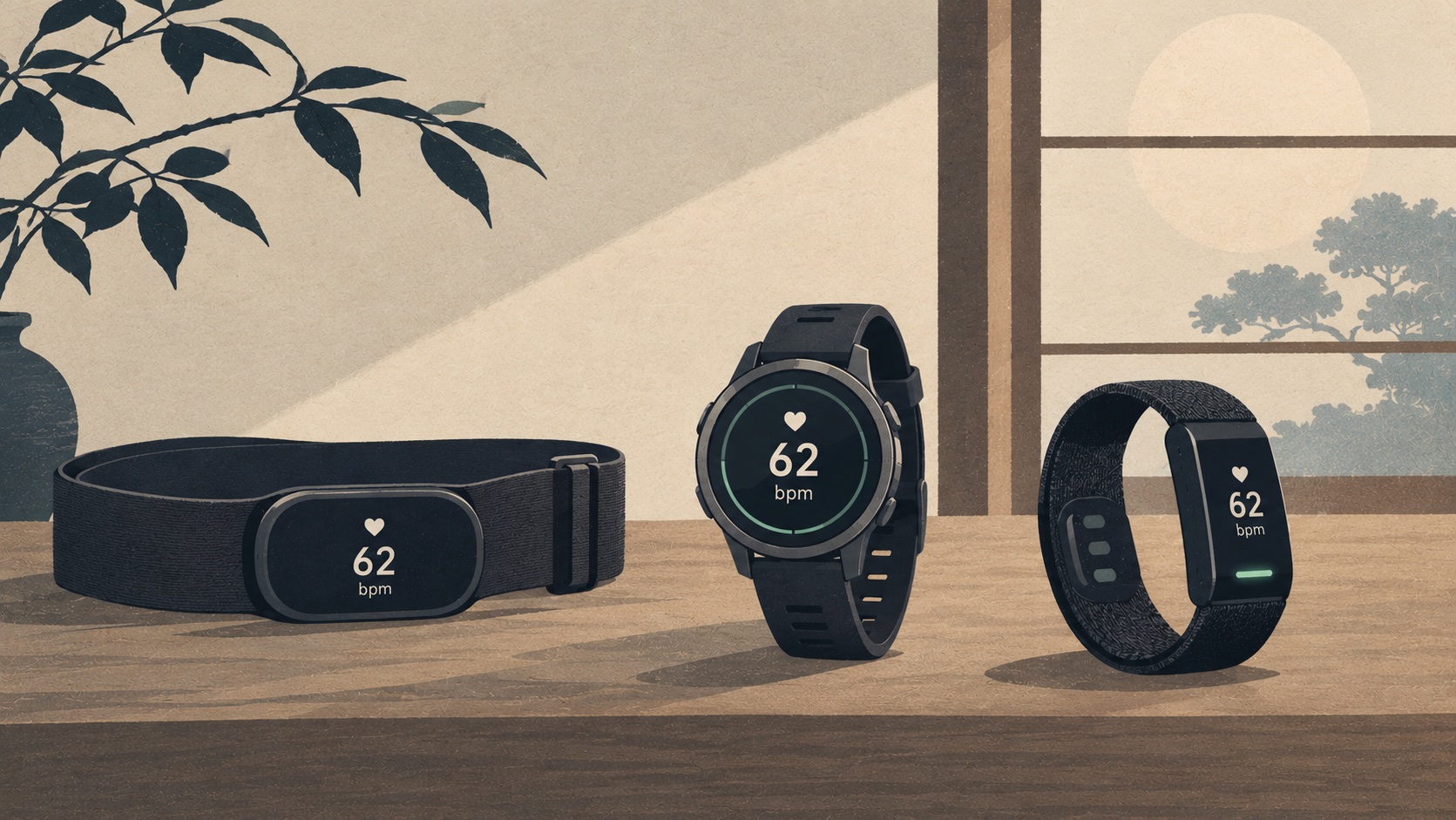
A chest strap, a watch and an optical arm band can all show 62 on the screen and still give an app very different data. Here's what the differences are, what we saw when we wore a strap and a watch at the same time, and which one we'd buy.
What your sensor actually sends
Every heart rate device detects heartbeats. What changes is how much detail it passes along. From most to least:
- Raw ECG. The heart's electrical signal. The Polar H10 can stream it about 130 times a second.
- RR intervals. The time between each pair of beats, in milliseconds: 987, 1052, 998, 1021. Chest straps work these out from the ECG and send them over Bluetooth, to within about a millisecond.
- Pulse intervals. The same idea, read from the pulse in your skin by an optical sensor. The timing is a little less precise, and few devices share it over standard Bluetooth.
- Averaged BPM. One number every second or so, usually a whole number, averaged over your last few beats. This is what most watches broadcast.
- Daily scores. Recovery, HRV status and the like, worked out overnight. Good for trends, but they say nothing about a live session. (We wrote about why.)
The middle three are what an app sees during a breathing session.
What each one is good for
No type is better across the board. Roughly:
- Effort on a run or ride: averaged BPM. A steady number is what you want.
- Resting and overnight trends: daily scores.
- Watching your heart rate follow a slow breath: any of them, including averaged BPM. RR intervals show it in finer detail.
- Comparing breathing paces: RR intervals for the finest detail, averaged BPM for a good estimate.
- HRV in milliseconds (RMSSD, SDNN): RR intervals. An averaged signal doesn't carry the beat-to-beat differences these numbers are built from.
- Checking for skipped or extra beats: ECG.
What we measured
We wore a Polar H10 and a Garmin Forerunner 165 (Broadcast Heart Rate on) together for 35 minutes, with the app running on the strap. The session had normal breathing, a full assessment, five minutes at a pace near the one it picked, five minutes at a faster pace, and some talking and shifting around. A Mac logged both sensors on one clock, plus the H10's raw ECG.
First, the strap. Across 1,959 beats, the intervals it reported were within a median of 2.4 ms of what we measured from its own ECG, so we used it as the reference.
The watch's reading arrives about 7 seconds after the strap's, which is normal for an averaged value, so the live graph trails the pacer a little.
The watch did well. We re-scored the six assessment paces from its data and got the same answer the app gave on the strap: 4.0 breaths per minute. Both dipped at 5.5 and peaked at 4.0. A watch gives you a decent estimate of your pace.
One caveat. 4.0 was the slowest pace tested, which is where a watch's signal is strongest, and we haven't yet recorded anyone whose best pace is nearer 6. If you want to be sure of your result, a strap is a good way to confirm it.
RMSSD, the HRV number in milliseconds, needs beat-to-beat intervals, so it's the one place we'd reach for a strap: it came out around 32 ms from the strap and 10 ms from the watch's BPM stream.
This was one person, one sitting and one watch model. Read it as an example, not a rating of any brand.
What we'd recommend
We are not affiliated with Polar, Garmin, Wahoo, Apple or any other sensor brand, and we receive no sponsorship, payment, free products or commission from any of them. This page has no affiliate links. The strap and watch we tested are our own.
For finding your pace and seeing the wave in detail, we'd go with a Polar H10 chest strap:
- It sends real RR intervals, so everything the app calculates comes from actual beat timing.
- Its timing checks out. That 2.4 ms figure is ours, and published studies against clinical ECG agree.
- There's no setup. It uses standard Bluetooth heart rate and starts when you put it on. No menu toggle, no bridge app.
The downside is wearing a strap. Wet the electrodes and put it on a minute or two beforehand so the signal settles. The Garmin HRM-Pro and HRM-Dual and the Wahoo TICKR also send RR intervals. Our device guide covers pairing.
If you have a watch
A watch works well with the app. It's already on your wrist, slow breathing gives it a wave big enough to show clearly, and it's the better choice for all-day and overnight tracking. Use it for the assessment and for practice. A strap is the upgrade when you want finer detail, want to confirm your pace, or want HRV in milliseconds. Plenty of people use both.
The app uses real RR intervals when a sensor sends them and falls back to BPM when it doesn't.